
Audience providers
Credit bureaus, banks, telcos, identity providers. You see customer life-stage, spend signal and location. We help you monetise it, without exposing it.
See your flow
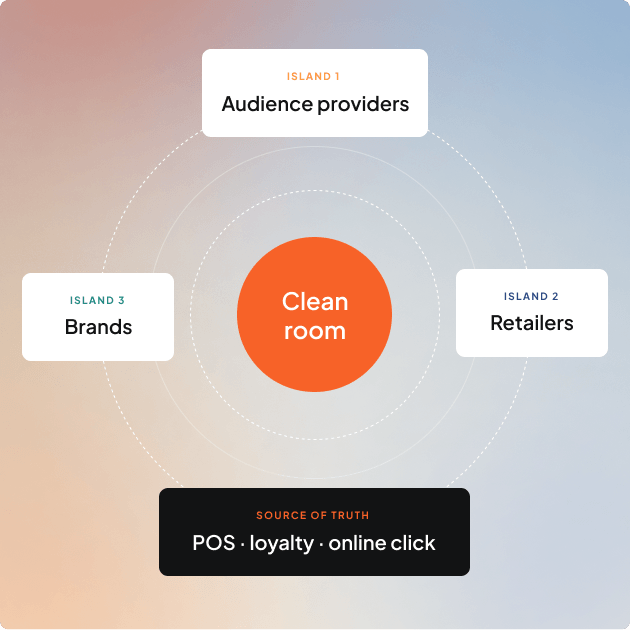
Audience providers, retailers, and brands each stay sovereign over their own data, connected through a POPIA-compliant cleanroom, yield layer, and closed-loop attribution tied to real purchases.
Audience providers, retailers and brands each sit on their own island. None of them want to hand over the underlying records. None of them have to. The cleanroom is where the signals meet, match and settle, without anyone giving up sovereignty.
Credit bureaus, banks, telcos, identity providers. You see customer life-stage, spend signal and location. We help you monetise it, without exposing it.
See your flowYou own the shoppers, the loyalty data and the physical and digital surfaces. Turn all of it into a media business.
See your flowYou want the right shopper, on the right surface, at the right moment. Then proof in the form of basket lift, not vanity metrics.
See your flowIsland 1 · Audience providers
Credit bureaus, banks, telcos, and identity providers see what retailers can't: life-stage changes, spend opportunity, mobility, and premium shifts. The challenge isn't insight — it's turning it into revenue without compromising data or corporate relationships.
For example: FNB · Standard Bank · Absa · Capitec · Nedbank · Vodacom · MTN · Discovery · TransUnion · Experian · Compuscan
Identify the signal
Life-stage triggers, spend opportunity, location patterns, premium moves, household shifts. Audiences already in your data.
Anonymise via cleanroom
Your records never leave your environment. Hashed IDs go into the cleanroom; matched segments come back out. No raw export, no new compliance surface.
Set rental terms
Which retailers can access. Which segments. Which use cases. Pricing per match, per impression or per cohort. You stay in control.
Publish to the pool
The audience appears as a bookable segment inside RetailPlus. Retailers and brands can match against it inside the cleanroom.
Earn on usage
Revenue share settled monthly, per match and per campaign. Audit-logged. Your existing corporate customers stay your customers.
The uplift
Data →
cash flow
Recurring, audit-logged, never exposed
The data stays where it is. The signal becomes the product. Retailers get richer targeting, brands pay for access, and you collect on every match. The corporates you already serve don't see you as a competitor, they see you as an upstream supplier making them better.
Bank-grade controls, cleanroom-only matching, and POPIA-aligned operator agreements mean the legal and compliance posture is the same as your existing data products. The commercial mechanics are new. The risk profile is not.
Island 2 · Retailers
You already have the inventory and audience. Most retailers only monetise a fraction because the operating model and integrations don't exist. RetailPlus changes that — three steps from owned surfaces to a scaled retail media network.
For example: Clicks · Dis-Chem · Pick n Pay · Woolworths · Shoprite · Checkers · Spar · Cape Union Mart · Mr Price · Sorbet · Lego stores
Activate your own surfaces
In-store screens, shelf-edge, app, web, email and push become priced and bookable inventory. Brands you already know can start buying.
Expose your first-party audience
Loyalty cohorts and transactional segments tagged and ready. Deep targeting against your own shoppers, deterministic match at the till.
Yield management kicks in
Dynamic pricing, frequency caps, surface-level optimisation, demand pacing. As your inventory gets scarce, you sell it for more, not less.
Rent in third-party audiences
Bank-grade audiences, identity partners and life-stage cohorts enrich your audience pool via cleanroom join. Higher CPMs, broader brand demand.
Three-way settlement runs
Brand pays you. Partners get their share. RetailPlus takes a small platform fee on the underlying spend. You keep the lion's share, automated.
The uplift
+30 to 90%
Network yield uplift across tiers
Your owned surfaces become a media network with the operating model running underneath. The brands you already work with come to you for media, not just shelf space. Trade marketing dollars convert into measurable media spend.
Then the second uplift: your audience data, exposed safely via cleanroom, gets rented by other retailers and brands inside the network. You monetise the same first-party data twice, on your surfaces and off them, without ever releasing the underlying records.
Island 3 · Brands
You want to reach the right shopper at the right moment, on the right surfaces, and prove every rand spent drove sales. Today, that means different platforms and attribution models. RetailPlus replaces that with one workflow.
For example: Vital · Nivea · Coca-Cola · Sorbet · Tiger Brands · Unilever · AVI · Distell · Procter & Gamble · Nestlé · Tastic · Sasko
Brief the audience
Pick from retailer loyalty cohorts, bank-grade life-stage segments, behavioural triggers and lookalikes. Rent the audience that fits the brief.
Pick the surfaces
In-store, app, web, email, DOOH, paid social, in-game, creators, content publishers. Every relevant surface for that audience, in one buy.
Match in the cleanroom
The audience is joined to the surfaces inside the cleanroom. No personal information is exposed to you, just the matched cohort and the CPMs.
Activate and pace
Creative routes to every surface in spec. Frequency caps applied across channels. Creator briefs and DOOH plays handled in the same flow.
Attribute to till
Exposure is stitched to actual purchase via POS feeds and online click. ROAS, lift study and pacing all run from the same attribution layer.
The uplift
ROAS,
signed-off
POS-stitched, finance-grade
One brief lands across every relevant surface for your audience. Audiences move with you across retailers and channels, while creative adapts automatically for each surface.
At the end of the campaign, closed-loop, POS-stitched attribution shows what every rand delivered. Next quarter's media plan is built from proven winners — no spreadsheet stitching required.
The mechanic that makes the three flows commercial is the attribution layer. Audience providers earn on matches. Retailers earn on impressions and on data rental. Brands pay for outcomes. The till feed is the source of truth, joined back through the cleanroom to the original exposure.
POS feeds, retailer loyalty match, online click, and cleanroom identity match all converge on a single attribution layer. Lift studies run against unexposed control cohorts. The next brief opens with last campaign's lift baked in. The next data rental period prices itself off realised match performance.
POPIA is not a checkbox. It is a set of rules about how personal information moves between parties. We built the platform so the rules are enforced by the architecture, not by trust. If any party in the chain tried to break them, the system would refuse to route.
All audience matching happens inside an accredited cleanroom. Banks, bureaus and retailers each contribute hashed identifiers. Nobody sees anyone else's underlying records.
Every data subject's consent is logged at the source. Withdrawal propagates through the cleanroom and removes the subject from all active matches.
RetailPlus is a written operator for each tenant. The terms bind us to the same standards the responsible party is bound to. Audit-logged, contractually enforceable.
Where infrastructure operates abroad, transfers route only through approved operators with POPIA-equivalent contractual protection.
Every party in the chain has a named Information Officer, contactable directly. Data subject requests can be lodged with any party and are routed accordingly.
Access, correction, deletion, objection, portability and the right not to be subject to automated decisions are exercisable across the whole chain.
Brands buy access to reach the audience, not the underlying data. Audiences are bookable, not downloadable. Section 18 notice obligations sit with the responsible party at source.
Section 22 incident response is part of the platform, not an afterthought. Notification to the Information Regulator and affected subjects runs through a tested process.

You don't need to redesign your privacy posture to participate. The platform inherits your responsible-party position and adds operator-grade controls on top. Banks, bureaus and retailers each retain control of their own data. Cleanroom matching gives you the commercial outcome without the legal and reputational risk of moving personal information around.
If your information officer wants a deeper read on the architecture, the data flow diagrams or the operator agreements, ask us. We don't hide the wiring.
30 minutes, screen-share, your role on the platform. We'll show you the specific flow, the specific commercial model and the specific POPIA posture for an audience provider, a retailer or a brand.
